-
Welcome to your new Gnomio site
Now, you are in control!
Moodle is an open-source Learning Management System (LMS) that provides educators with the tools and features to create and manage online courses. It allows educators to organize course materials, create quizzes and assignments, host discussion forums, and track student progress. Moodle is highly flexible and can be customized to meet the specific needs of different institutions and learning environments.
Moodle supports both synchronous and asynchronous learning environments, enabling educators to host live webinars, video conferences, and chat sessions, as well as providing a variety of tools that support self-paced learning, including videos, interactive quizzes, and discussion forums. The platform also integrates with other tools and systems, such as Google Apps and plagiarism detection software, to provide a seamless learning experience.
Moodle is widely used in educational institutions, including universities, K-12 schools, and corporate training programs. It is well-suited to online and blended learning environments and distance education programs. Additionally, Moodle's accessibility features make it a popular choice for learners with disabilities, ensuring that courses are inclusive and accessible to all learners.
The Moodle community is an active group of users, developers, and educators who contribute to the platform's development and improvement. The community provides support, resources, and documentation for users, as well as a forum for sharing ideas and best practices. Moodle releases regular updates and improvements, ensuring that the platform remains up-to-date with the latest technologies and best practices.
Links of interest:
(You can edit or remove this text)-
INTRODUCTION
Unit Description
This unit specifies the competencies required to perform road construction works. It involves carrying out earthwork activities, constructing road/pavement structure layers and constructing parking, walk ways and cyclist lanes, foot bridges and bus bays. It also includes installing road furniture, construction of erosion prevention structures, constructing highway drainage and hydraulic structures and undertaking highway maintenance.
-
Available courses
- Teacher: Admin User
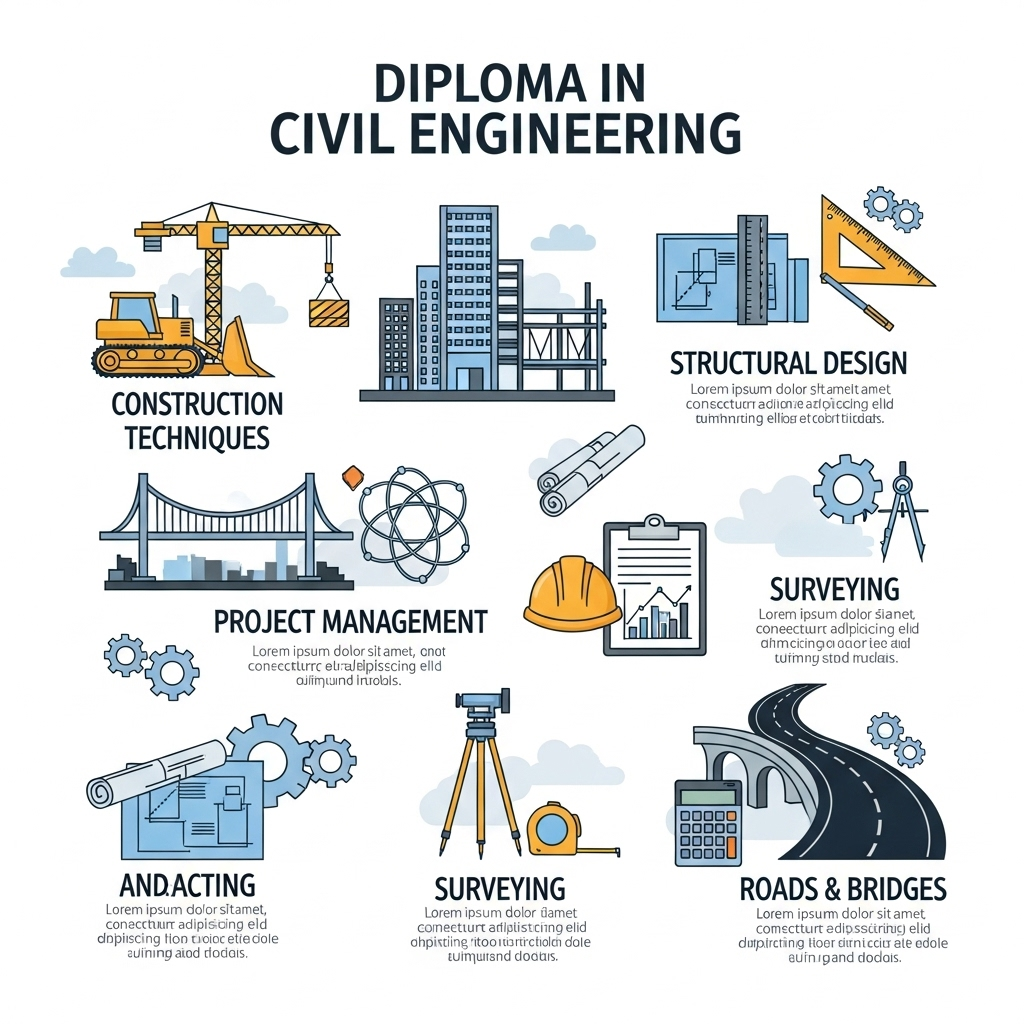
The Diploma in Civil Engineering is a specialized technical program designed to equip students with practical and theoretical knowledge in the field of civil engineering. This course typically spans 2 to 3 years, depending on the institute and country, and prepares students for careers in construction, infrastructure development, and related engineering sectors.
Core Subjects Covered:
Engineering Mathematics: Fundamental mathematical concepts including algebra, geometry, trigonometry, calculus, and statistics are studied to aid in engineering problem-solving and design.
Engineering Mechanics: Principles of forces, moments, equilibrium, and dynamics as applied to structures and materials.
Building Materials and Construction: Study of various construction materials like concrete, steel, wood, and their properties, along with construction techniques, workmanship, and quality control.
Surveying: Techniques and instruments used for land surveying, measurements, mapping, and site layout planning.
Structural Analysis: Understanding of load distribution, stress, strain, and behavior of different structural elements such as beams, columns, and slabs.
Concrete Technology: Study of concrete composition, mix design, curing, and testing methods to ensure durability and strength.
Geotechnical Engineering: Basics of soil mechanics, soil properties, and foundation design to support structures.
Transportation Engineering: Fundamentals of road, railway, and bridge construction, including traffic management and planning.
Hydraulics and Water Resources Engineering: Study of fluid mechanics, water supply systems, irrigation, and drainage infrastructure.
Environmental Engineering: Introduction to waste management, pollution control, and sustainable construction practices.
Construction Management and Estimation: Techniques for project planning, cost estimation, resource management, and site supervision.
Practical Training:
The course includes extensive laboratory work, field visits, and project work to provide hands-on experience in surveying, material testing, drafting, and construction management.
Career Prospects:
Graduates are prepared for roles such as Junior Engineers, Site Supervisors, Surveyors, Estimators, and Technicians in construction firms, government agencies, infrastructure companies, and consultancy firms. The diploma also serves as a foundation for further studies like a Bachelor’s degree in Civil Engineering.
- Teacher: Admin User