- Teacher: Admin User
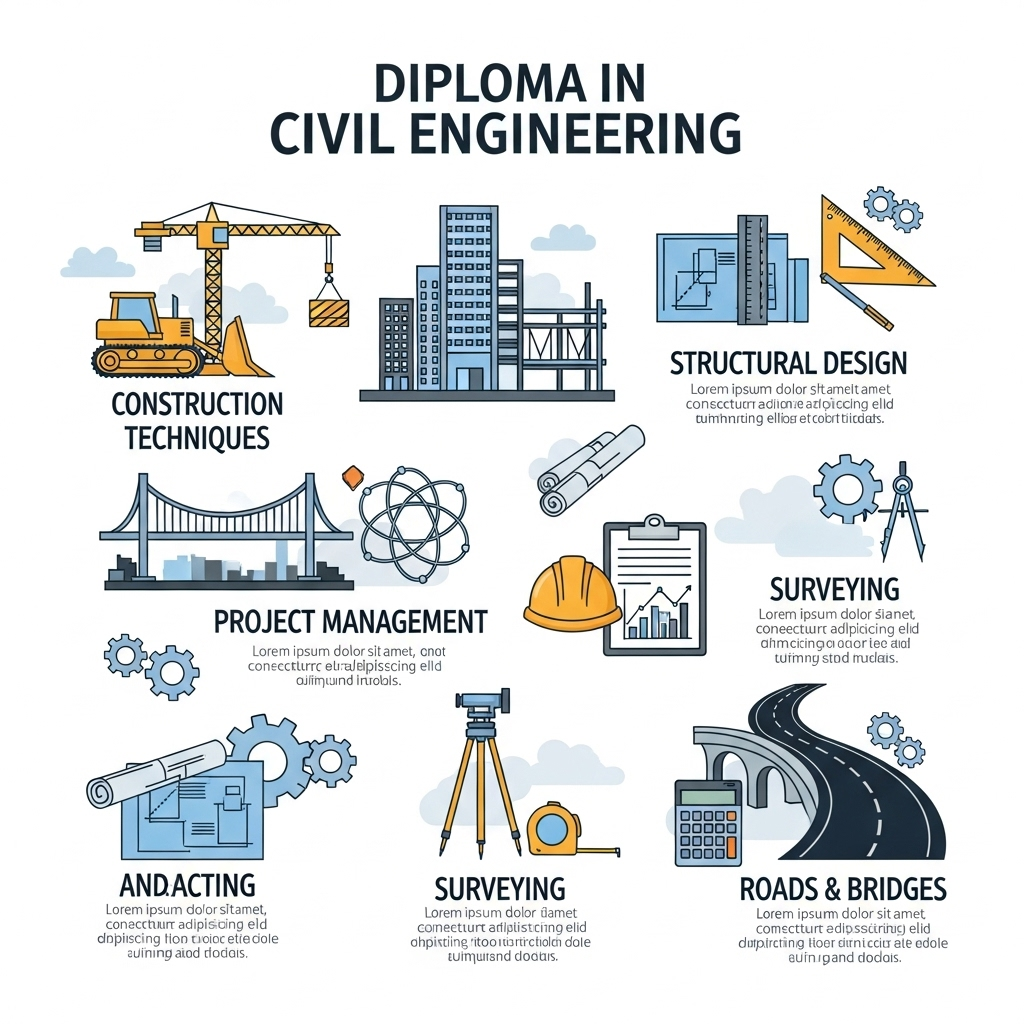
The Diploma in Civil Engineering is a specialized technical program designed to equip students with practical and theoretical knowledge in the field of civil engineering. This course typically spans 2 to 3 years, depending on the institute and country, and prepares students for careers in construction, infrastructure development, and related engineering sectors.
Core Subjects Covered:
Engineering Mathematics: Fundamental mathematical concepts including algebra, geometry, trigonometry, calculus, and statistics are studied to aid in engineering problem-solving and design.
Engineering Mechanics: Principles of forces, moments, equilibrium, and dynamics as applied to structures and materials.
Building Materials and Construction: Study of various construction materials like concrete, steel, wood, and their properties, along with construction techniques, workmanship, and quality control.
Surveying: Techniques and instruments used for land surveying, measurements, mapping, and site layout planning.
Structural Analysis: Understanding of load distribution, stress, strain, and behavior of different structural elements such as beams, columns, and slabs.
Concrete Technology: Study of concrete composition, mix design, curing, and testing methods to ensure durability and strength.
Geotechnical Engineering: Basics of soil mechanics, soil properties, and foundation design to support structures.
Transportation Engineering: Fundamentals of road, railway, and bridge construction, including traffic management and planning.
Hydraulics and Water Resources Engineering: Study of fluid mechanics, water supply systems, irrigation, and drainage infrastructure.
Environmental Engineering: Introduction to waste management, pollution control, and sustainable construction practices.
Construction Management and Estimation: Techniques for project planning, cost estimation, resource management, and site supervision.
Practical Training:
The course includes extensive laboratory work, field visits, and project work to provide hands-on experience in surveying, material testing, drafting, and construction management.
Career Prospects:
Graduates are prepared for roles such as Junior Engineers, Site Supervisors, Surveyors, Estimators, and Technicians in construction firms, government agencies, infrastructure companies, and consultancy firms. The diploma also serves as a foundation for further studies like a Bachelor’s degree in Civil Engineering.
- Teacher: Admin User